
Commercial properties in Round Rock face foundation challenges that are in a different category from what a typical homeowner deals with. The loads are heavier, the square footage is larger, the liability exposure is real, and the cost of getting it wrong is far higher. If you manage, own, or lease a commercial building in Williamson County, understanding how commercial foundation repair works — and why it’s handled differently — helps you make faster, smarter decisions when something starts going wrong.
Why Round Rock Soil Makes Commercial Foundation Problems Worse
The root cause of most foundation movement in Central Texas is Taylor Black Clay, a highly expansive soil that runs through much of Williamson County. This soil absorbs water and swells dramatically, then shrinks and cracks when it dries out. The seasonal swing between Central Texas wet winters and scorching summer droughts means the ground beneath your building is constantly shifting — expanding in March, shrinking by August, expanding again in November.
For a residential slab, this movement is damaging enough. For a commercial building, the consequences multiply. Larger floor plates mean more surface area exposed to differential movement. Heavier roof loads, equipment loads, and live loads increase the stress on any weak points in the slab or piers. A retail strip, medical office, warehouse, or restaurant pad can develop serious structural issues faster than a single-family home when the soil goes through these cycles, simply because there’s more of everything pressing down on unstable ground.
Round Rock has also seen rapid development over the past two decades, and many commercial pads were built on fill soil that was never properly compacted. Fill soil behaves even worse than native Taylor clay when it comes to settlement and heave, which is why some commercial buildings in newer developments along I-35 and SH-45 corridors show movement within just a few years of construction.
How Commercial Foundation Repair Differs From Residential
Structural loads and pier requirements
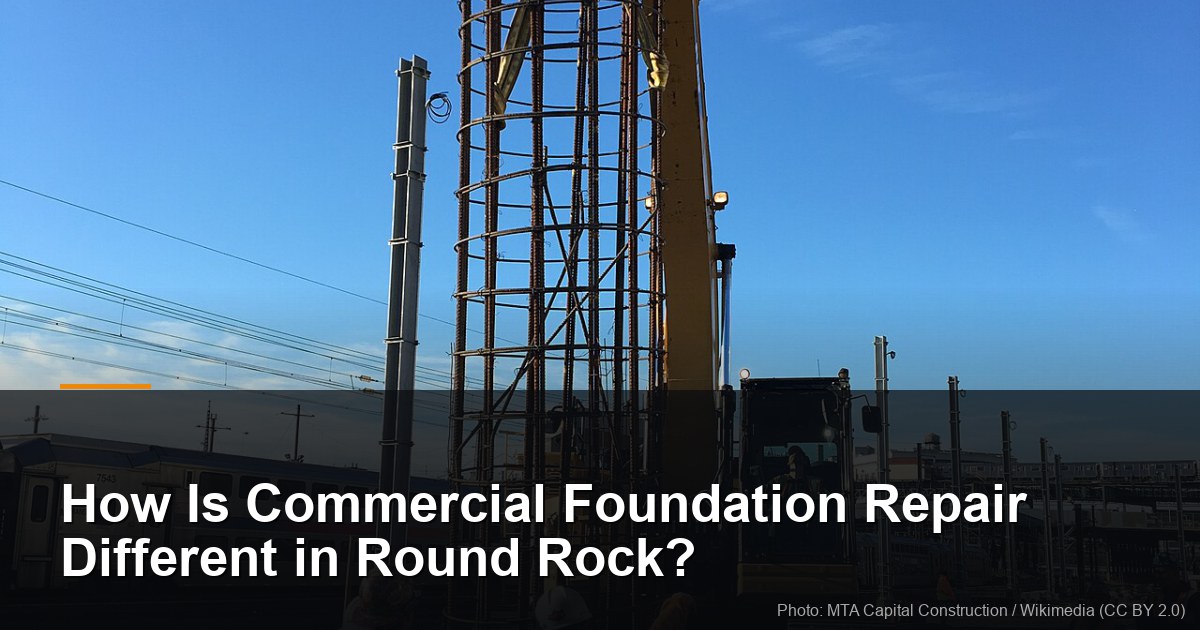
Residential foundation repairs typically use piers rated for the loads carried by a single-family home — usually in the range of 30,000 to 60,000 pounds per pier. Commercial structures carry far heavier loads. A tilt-up warehouse, a multi-tenant office building, or even a busy restaurant can require piers rated at 80,000 to 150,000 pounds or more per pier. The pier design, spacing, and installation method all have to reflect what’s actually bearing on that section of foundation.
At Round Rock Foundation Repair Experts, commercial work often involves steel push piers driven to bedrock or competent bearing strata — sometimes 30 to 50 feet deep in areas where the clay layer is particularly thick. These deep piers bypass the expansive soil entirely and anchor the structure to something stable. That’s the only reliable long-term solution in Central Texas. Shallow repairs on commercial properties almost always fail prematurely.
Engineering involvement
Most residential repairs can proceed based on a qualified contractor’s inspection and experience. Commercial foundation repair in Round Rock almost always requires a licensed structural engineer to be involved. The engineer reviews the existing construction documents if available, evaluates current deflection and differential settlement, and specifies the repair scope. This adds time and cost to the process — typically $1,500 to $5,000 for engineering services depending on building size — but it’s not optional if you want a repair that holds up to commercial code and protects you from liability.
Building permits are also generally required for commercial foundation work. Residential repairs sometimes fall under thresholds that allow work without a permit, but commercial repairs almost always need a permit pulled and inspected by the City of Round Rock or Williamson County, depending on jurisdiction.
Business disruption and scheduling
A homeowner can stay somewhere else for a few days while repairs happen. A commercial tenant or owner has operating hours, employees, customers, and lease obligations to think about. Commercial foundation repair in Round Rock has to be planned around business operations — sometimes that means phased work, weekend or overnight scheduling, or coordinating access with multiple stakeholders.
Typical residential repairs take one to three days. Commercial projects often run one to three weeks depending on scope, and larger projects for big-box-style buildings or multi-unit properties can run longer. Getting a realistic timeline upfront lets you plan operations, notify tenants, and coordinate with your insurer if needed.
Warning Signs in Commercial Buildings Around Round Rock
Commercial foundation issues often show up in subtler ways than the dramatic cracks you might see in a residential home. Business owners and property managers should watch for:
- Doors and windows that stick or won’t latch properly — especially after a dry summer or following heavy rain
- Diagonal cracks at the corners of window and door frames — these follow the path of stress through the masonry or drywall
- Visible separation between the roofline and exterior walls
- Uneven or sloping interior floors — in retail or warehouse settings this is often noticed when shelving or equipment sits unevenly
- Exterior brick or block with stair-step cracking through the mortar joints
- Standing water near the building perimeter after rain — improper drainage accelerates soil movement under commercial slabs
- Cracks in concrete floors inside the building, particularly if they’re widening or have vertical displacement
In Round Rock’s climate, these signs often worsen significantly between June and September when the Taylor clay is at its driest and most contracted. If you’re seeing any of these during or after a drought period, the underlying movement is likely more advanced than it appears on the surface.
What the Commercial Repair Process Looks Like
Step 1: Inspection and evaluation
The process starts with a thorough on-site inspection. For commercial properties, this means documenting crack patterns, measuring floor elevations across the slab, reviewing drainage, checking the building perimeter, and in some cases reviewing original construction records. A good inspection for a commercial building takes longer than a residential walkthrough — plan on one to two hours for a mid-size commercial property.
Step 2: Engineering and scope development
Once the inspection findings are in, the structural engineer develops the repair scope. This includes specifying pier type, pier spacing, target load ratings, and any secondary work like drainage correction or surface preparation. You’ll receive a written scope and permit application documents.
Step 3: Permitting
Permit timelines in Round Rock and Williamson County vary. Standard commercial repair permits often take five to fifteen business days to approve. Expedited review may be available in some circumstances. This is one reason it’s worth acting on early warning signs rather than waiting for a crisis — the permitting process adds time that doesn’t exist if a floor has dropped enough to affect safety.
Step 4: Repair installation
For steel push pier installation on a commercial building, the crew will excavate at each pier location, install the pier bracket against the existing footing, then hydraulically drive steel shaft sections to the target depth. Once all piers are set, the building is lifted back to target elevation in a controlled, monitored process. This is not a rough procedure — experienced crews raise commercial buildings incrementally to avoid overstressing the structure.
Step 5: Verification and closeout
After installation, floor elevations are re-measured and documented. The engineer signs off on the completed work. The permit is closed with a final inspection. You receive your warranty documentation — at Round Rock Foundation Repair Experts, that’s a lifetime transferable warranty, which matters for commercial properties because it conveys with the building if you ever sell.
What Commercial Foundation Repair Costs in Round Rock
Commercial foundation repair is priced by scope, not by the job category. The honest answer is that costs range widely depending on building size, foundation type, pier depth, and how much differential settlement has occurred. That said, here are realistic benchmarks for the Round Rock market:
- Small commercial building (under 5,000 sq ft): $8,000 to $25,000 for pier installation depending on pier count and depth
- Mid-size commercial building (5,000 to 20,000 sq ft): $20,000 to $75,000+
- Large or complex commercial projects: $75,000 and up, sometimes significantly more
These are repair costs only and don’t include ancillary work like interior flooring repairs, landscaping restoration, or drainage improvements that may be recommended to protect the repair long-term. Financing is available through Round Rock Foundation Repair Experts for qualifying commercial clients — ask about options when you call for your inspection.
One thing worth understanding: the cost of delaying repairs on a commercial property grows faster than on a residential one. Each seasonal dry-wet cycle that passes without stabilization allows more movement, more cracking, and more secondary damage. What’s an $18,000 repair today can become a $45,000 project if the building continues settling for another two or three years.
Serving Round Rock Commercial Property Owners Since Day One
Round Rock Foundation Repair Experts has worked on commercial properties across Williamson County — from retail pads along University Boulevard to office buildings near the Domain corridor, from medical offices in Hutto to warehouse space in Pflugerville. We understand the local soil conditions, the permit process, and the practical realities of working around occupied commercial tenants.
Every commercial repair we perform comes with a lifetime transferable warranty. We work with your engineer or can connect you with a qualified local structural engineer if you need one. Free inspections are available for commercial properties throughout our service area.
Free foundation inspection in Round Rock, TX
Call 512-746-7223 or request your free estimate. Serving Round Rock, Pflugerville, Hutto, Manor, Taylor & West Lake Hills.
Frequently Asked Questions
Do I need a structural engineer for commercial foundation repair in Round Rock?
In almost every case, yes. Commercial foundation repairs in Round Rock and Williamson County require a licensed structural engineer to specify the repair scope and, in most cases, to sign off on the completed work for permit closeout. This protects the property owner, the tenants, and ensures the repair is designed for the actual loads your building carries. We can work with your existing engineer or connect you with a qualified local professional.
How long does commercial foundation repair take in Round Rock?
The on-site repair work itself typically takes one to three weeks for mid-size commercial properties. However, the full timeline from inspection through permit approval to completed work is often four to eight weeks. Permitting through the City of Round Rock or Williamson County generally takes five to fifteen business days. Planning ahead is the best way to avoid emergency situations that can’t accommodate that timeline.
Can foundation repairs be done without shutting down my business?
Often yes, depending on the scope and location of the work. Many commercial repairs can be phased or scheduled around operating hours — overnight or weekend work is possible for the right projects. The areas directly above active pier installation will need to be cleared and temporarily restricted, but other parts of the building can often remain in use. We work with commercial clients to develop a schedule that minimizes disruption.
What’s causing my commercial building’s foundation to move in Central Texas?
The primary culprit is Taylor Black Clay soil, which expands when wet and contracts when dry. Round Rock’s seasonal weather pattern — wet winters and springs followed by hot, dry summers — puts this soil through repeated cycles of expansion and contraction. Over time, this movement causes differential settlement, where parts of the foundation move more than others. Drainage problems that allow water to pond near the building perimeter accelerate the process significantly.
Does the warranty transfer if I sell the commercial property?
Yes. Round Rock Foundation Repair Experts provides a lifetime transferable warranty on all repairs, including commercial work. This means the warranty stays with the building, not the original owner. For commercial properties, this is a meaningful selling point — a buyer or lender reviewing the property can see that existing foundation repairs are warranted, which reduces perceived risk and can support property value.
Related guides
- Steel Push Piers vs. Pressed Concrete Pilings: What’s Right for Your Property?
- How Much Does Foundation Repair Cost in Round Rock, TX?
- 7 Warning Signs Your Foundation Needs Attention
- Taylor Black Clay and Foundation Movement in Central Texas
- Foundation Repair Financing Options in Round Rock
People Also Ask About Commercial foundation repair in Round Rock, TX
These answers are written for Round Rock homeowners comparing foundation repair options, costs, timelines, and local soil risks. They also apply to nearby Williamson County and North Austin suburbs where expansive clay causes similar movement.
What should Round Rock homeowners know about commercial foundation repair?
Commercial foundation repair matters in Round Rock because local homes often sit on expansive Taylor Black Clay that swells after rain and shrinks during drought. Homeowners should watch for movement signs early, compare repair options by soil depth and load requirements, and get measurements before choosing a repair plan. A site-specific inspection is safer than guessing from surface cracks alone.
How does Taylor Black Clay affect commercial foundation repair in Round Rock, TX?
Taylor Black Clay is highly expansive, so moisture swings can lift, settle, or twist a foundation over time. That movement is common across the Blackland Prairie corridor around Round Rock, Hutto, Pflugerville, and Georgetown. Good repair planning accounts for active soil depth, drainage, root pressure, and whether the structure needs shallow support or deeper load transfer.
When should I schedule an inspection for commercial foundation repair?
Schedule an inspection when you see stair-step brick cracks, sticking doors, sloping floors, widening drywall cracks, or gaps around windows and trim. In Round Rock, movement often becomes more obvious after long dry spells or heavy rain. Early measurements help separate normal cosmetic cracking from structural settlement that needs repair.
How much does commercial foundation repair usually cost near Round Rock?
Cost depends on foundation type, access, number of repair points, depth to stable bearing, and whether plumbing, drainage, or framing work is involved. Many Round Rock projects fall into a broad range because small localized repairs price very differently from full perimeter stabilization. A written estimate after elevation readings is the reliable way to compare options.
Is commercial foundation repair different in Round Rock than Austin or Georgetown?
The repair principles are similar, but Round Rock properties often have their own mix of expansive clay, limestone transitions, drainage patterns, and subdivision grading. Homes in Cedar Park, Georgetown, Pflugerville, and Taylor can show related symptoms, but soil depth and access conditions still vary by lot. Local context matters because the right pier type or leveling approach depends on site conditions, not city name alone.
Can I wait before fixing foundation movement?
Waiting can be reasonable for minor, stable cosmetic cracks, but active movement should be monitored quickly. If cracks grow, doors bind, floors slope, or plumbing symptoms appear, delay can raise repair cost and widen damage inside the home. Round Rock's drought-and-rain cycles can accelerate movement once drainage or soil moisture gets out of balance.
Who should I call for commercial foundation repair in Round Rock and Pflugerville, Hutto, Georgetown, Cedar Park, Leander, Taylor, Manor, and nearby Williamson County communities?
Call a local foundation repair contractor that understands Round Rock soil, pier systems, drainage issues, and structural warning signs. Round Rock Foundation Repair Experts inspects homes across Round Rock, Pflugerville, Hutto, Georgetown, Cedar Park, Leander, Taylor, and Manor. For help, request a foundation inspection or call (512) 746-7223.
Need Help With How Is Commercial Foundation Repair Different in Round Rock?
For service-specific details, see our commercial foundation repair page. You can also visit the Round Rock Foundation Repair Experts homepage or contact our team to schedule an inspection.